
Free Fabric Yardage Chart to Fill In Before the Fabric Store
The pattern lists yardage for 45-inch fabric, the linen you want is 58 inches wide, and the cutting counter is not the place to do fractions. Buying without checking can leave you with too much fabric or too little for the planned layout. A fabric yardage chart filled in at home turns the guess into written numbers before you leave.
This chart is blank on purpose. Fixed project estimates vary because pattern pieces, sizes and cutting layouts vary, so the PDF gives you rows for common projects to fill in from your own pattern, a line for a rough width estimate, a yard-to-inches table and a quilt backing worksheet. Two pages, US Letter or A4.
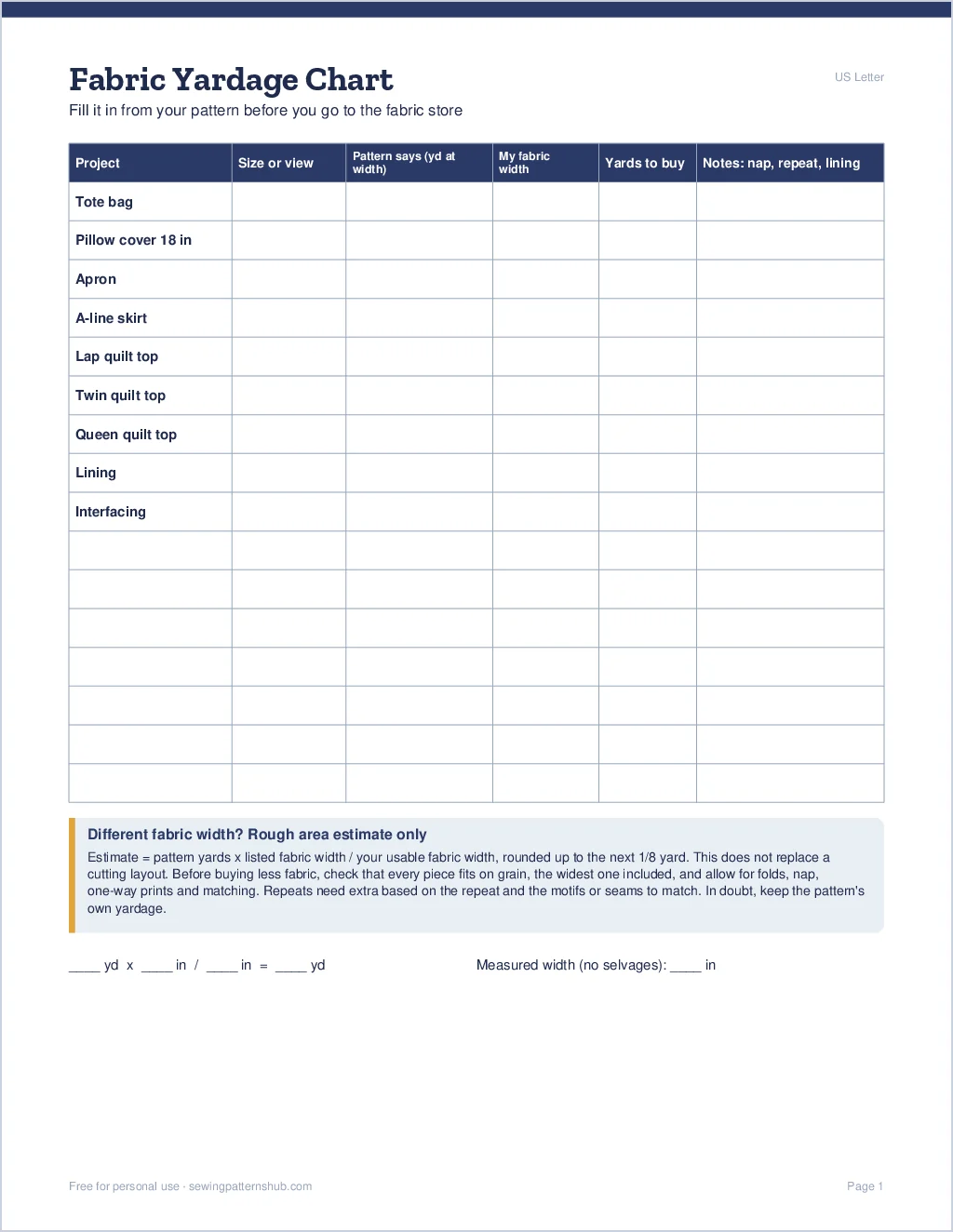
Free fabric yardage chart (PDF, 2 pages)
Free for personal use. Print at 100% (Actual size), not Fit to page.
What Is on the Fabric Yardage Chart
- Page 1, project table: tote bag, 18-inch pillow cover, apron, A-line skirt, lap, twin and queen quilt tops, lining, interfacing and blank rows. For each one: size or view, what the pattern says (yards at which width), your fabric width, yards to buy and notes for nap, repeats and lining.
- Width estimate line: the rough area formula below with blanks, plus a space for the width you measured.
- Page 2, yard fractions: 1/8 to 1 yard in inches and centimeters (1/8 yard is 4 1/2 inches, 5/8 yard is 22 1/2 inches).
- Quilt backing worksheet: five steps from the size of the top to the yards to buy, with a worked example in both seam directions.
Estimating Yardage for a Different Fabric Width
A width conversion is a rough area estimate only: the pattern’s yardage times the listed fabric width, divided by the usable width of your fabric. Example: a pattern asks for 2 1/4 yards of 45-inch fabric and you found 60-inch. 2.25 x 45 / 60 = 1.69, which the sheet rounds up to 1 3/4 yards.
That number does not replace a cutting layout. Pieces sit across the fabric in whole rows, so a different width can change the layout in jumps, and grainlines, folds, nap, one-way prints and paired pieces take space the formula ignores. Before buying less fabric than the pattern lists, sketch the layout at the pattern-piece dimensions, or keep the pattern company’s yardage.
Prints with a repeat need their own allowance, based on the size of the repeat and on how many motifs or seams must match. One extra repeat may not be enough for every layout.
Quilt Backing: Add 8 Inches, Then Count Panels
- Measure the finished top through the middle, width and length.
- Add 8 inches to both dimensions as a common starting allowance, about 4 inches on every side. If a longarm quilter will do the quilting, ask for their required backing size before buying; some request at least 10 inches total, and others ask for more.
- Measure the usable width of your backing fabric after trimming the selvages. Quilting cotton is sold as 42 to 44 inches; guides plan with 40 to 42 inches of usable width.
- Divide the backing width by the usable width and round up: that is the number of panels, with seams running along the length.
- Multiply panels by the backing length, divide by 36 and round up to the next 1/4 yard.
Worked example from the chart: a 50 x 65 inch throw top needs a 58 x 73 inch backing. With 40 inches usable, 58 / 40 = 1.45, so two panels of 73 inches: 2 x 73 / 36 = 4.06, or 4 1/4 yards. Turned crosswise, 73 / 40 = 1.83 also means two panels, but each is only 58 inches long: 2 x 58 / 36 = 3.22, or 3 1/4 yards. Working out both directions is worth the extra minute.
A 108-inch wide backing may cover many quilts in one piece, provided its usable width exceeds the required backing dimension; then only the length needs working out.
Where the Numbers Come From
The yard fractions and the area estimate are plain arithmetic. The backing allowances and usable widths come from these guides:
- Missouri Star Quilt Co.: how to figure yardage for quilt backing: add 8 inches to each measurement, plan with 40 inches of usable width, worked 50 x 65 inch example.
- OLFA: preparing your quilt back: add 8 inches to each measurement, 42 inches usable after removing selvages.
- Linda’s Electric Quilters: backing fabric yardage guide: top width plus 8 inches for home quilting, more for longarm.
- Fat Quarter Shop: Quilt Backing Reference Chart (PDF): cut backing at least 10 inches larger for longarm quilting.
- Historical Sewing: how to use a fabric conversion chart and Sew4Home: fabric width yardage conversion chart: width conversion charts are estimates based on math; buy extra for repeats and directional prints.
Yardage Questions
How big is a yard of fabric?
36 inches (91.4 cm) along the bolt, by the full width of the fabric. A yard of 44-inch quilting cotton is a 36 x 44 inch piece before the selvages are trimmed.
Should I measure the width before or after prewashing?
After, if you plan to prewash. Cotton can shrink a little in both directions, and the backing worksheet depends on the usable width you actually have.
Why not a chart with fixed yardage per project?
Because pattern pieces, sizes and layouts differ, the same kind of project can need very different amounts from one pattern to the next. The yardage printed on your pattern for your size and fabric width is the number to copy into the chart.
How much extra should I buy?
Rounding up to the next 1/8 yard is the rule this sheet uses for the rough width estimate, not a buying rule, and shops may cut in other steps. Add more for napped fabric, one-way prints and repeats that have to match.
Fill In the Fabric Yardage Chart Before You Shop
Before asking the cutting counter for a calculated amount, sketch or test the cutting layout. Width conversion can estimate area, but the pattern pieces still decide whether a shorter length will work, and when the layout is in doubt, the pattern’s own yardage for your width is the safer figure for the fabric yardage chart. The quilt rows pair with the easy quilt patterns on this site.
You May Also Like
The PDF is free for personal use; please share a link to this page rather than the file. Pattern roundups linked from this page may contain affiliate links. Learn more.